

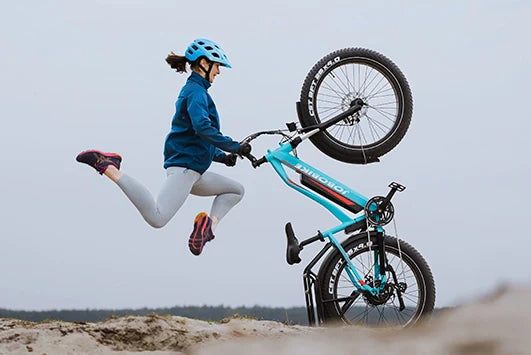
Fat bikes are often associated with snow, sand, and challenging mountain trails. Their oversized tires and all-terrain design have earned them a reputation for mastering extreme terrain. As a result, they are often considered special vehicles for certain adventures – and not exactly the bike for an all-day tour. But is this reputation still justified today?
As e-bikes become a daily means of transport for more and more people, it's worth taking a fresh look at the topic – this time from a more comprehensive perspective. It's not just about performance in rough terrain, but also about comfort over longer periods of time, motor support and the flexibility that allows it to be used in everyday life.
Comfort on long journeys
The difference between bicycles may be small on short journeys – but the longer the distance, the more important comfort becomes. How the hands feel, whether the sitting posture holds up, how well the bike cushions bumps – all these details add up, kilometre after kilometre.
And this is where fat bike show an unexpected strength: their large-volume tires with low air pressure and a wide contact surface naturally absorb vibrations. This reduces fatigue and ensures a more pleasant ride on changing surfaces. In addition, there is the psychological feeling of stability – you can keep your own pace, you don't have to constantly pay attention to every unevenness in the ground. On long distances, this feeling of security is a real advantage.
A few compromises – but less than expected
It's true: fat bikes weren't designed for efficient use on asphalt. Their wide tires generate more rolling resistance, and the total weight is usually higher than that of classic touring bikes. If maximum range or speed without a motor is required, there are lighter alternatives.
But with electric drive, the game changes. A reliable motor balances the pace, makes climbs easier and maintains speed even in headwinds or with luggage. What used to be considered a disadvantage becomes almost irrelevant – often you don't even notice it while driving. The off-road DNA of the fat bike suddenly shows completely new strengths - especially when the road conditions are not perfect.
Real solutions for real routes
An electric fat bike can be an extremely versatile vehicle – provided it's designed not only for trails, but also for longer rides. At JOBOBIKE, we develop models that combine off-road capability with long-distance comfort – for riders who want more than just a special device.
A good example is our Eddy model: foldable, full suspension and equipped with wide tires that provide comfort both on bad asphalt and on uneven paths. It fits just as well in the trunk as it does in a full day of driving pleasure. If you're looking for even more off-road expertise, the Eddy X is the ideal partner – compact, practical and made for more demanding routes.
And then there's Apex, a fat bike that convinces with stability and strength on any surface. Whether it's a forest path or a country road , this model remains confident, offers control and comfort, and motivates you to drive further than turn around sooner.
Fat bike for the long distance? Definitely – if you choose it wisely
Long rides put every bike to the test. A model that feels good for the first few kilometers can become a burden after several hours. But fat bikes, especially in their electric version, have long been more than just winter or adventure machines. When thoughtfully designed, they offer a rare combination of control, cushioning and power.
It's often not the technical data that makes the difference – but the riding experience, the balance or the reassuring feeling of being able to rely on the bike. It is precisely these factors that determine the success of a long tour. And a well-chosen fat bike has everything it takes to get you to your destination – with a smile on your face.
Tags:
Related articles
-
Jul 31 2025
Why Choose JOBOBIKE?
-
Jul 30 2025
